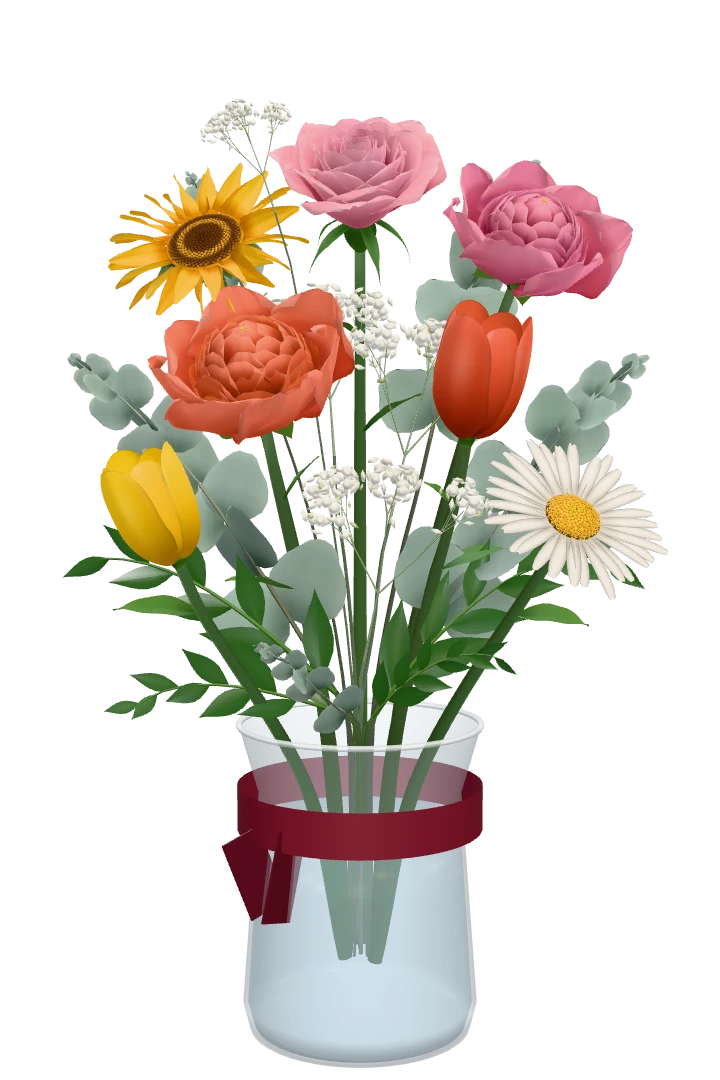
The flowers open first, but the words are what people remember. When someone opens a bouquet from MyBouquet, they see who it is for and who it is from, tap “Open your bouquet” and watch the flowers open one by one. Then your message is there, in your words. This guide has message ideas for the occasions people send bouquets for most, with a few notes on tone. Copy one, change a word, or use it to find your own.
What makes a message work
You have up to 500 characters for the message and 40 for the ribbon around the vase. That is room for a few sentences, and a few sentences is usually right. Some things that tend to help:
- Use their name, or the name you actually call them. The bouquet already says “For Sam” at the top; “Sammy” in the message is warmer.
- Say one specific thing. “Thank you for the soup on Tuesday” stays with someone longer than “thanks for everything”.
- Match the length to the moment. A birthday can be one line; an apology usually needs three.
- Read it out loud once. If it sounds like a shop card, swap one word for the word you would really say.
- Keep the ribbon short: two to five words, like “Happy 30th”, “Still yours” or “Sorry, love”.
Birthday messages
A birthday bouquet is the easiest one to get right, and the one most often set to open at midnight. The birthday bouquet starts with peonies, which stand for happiness and a good year ahead.
Happy birthday! I hope this year is as bright as you are.
First one to say it: happy birthday. The cake is on me next time.
Another year of you being you. Lucky us.
I can’t be there to sing, so here are some flowers instead. Have the best day.
For a milestone, name it: “Thirty looks good on you.” For a friend you rarely see, add a memory you share, even a small one. It shows you didn’t just remember the date, you remembered them.
Love and Valentine’s Day
Roses say this without help, which is why the love bouquet and the Valentine’s bouquet start with them. What each colour of the rose means is on its own page.
No reason. Just you.
You make an ordinary Tuesday feel like something.
Happy Valentine’s Day. Still choosing you, every year.
I fell for you a little more this week. Thought you should know.
A love note doesn’t have to be long. The shortest ones often land best, because there is nothing in them to skim.
Mother’s Day and thank you
A thank-you lands best when it names the thing. Daisies lead the thank-you bouquet: friendship without fuss. The Mother’s Day bouquet has its own page, with the dates in different countries.
Thank you for every lift, every lunchbox and every “text me when you’re home”.
Mum, you made it look easy. I know now it wasn’t. Thank you.
Thank you for looking after the cat. She clearly prefers you now.
You helped more than you know. Thank you.
Saying sorry
An apology is the message where flowers help least and words matter most. The bouquet opens the door; the message has to walk through it. Say what you did, say you are sorry, and leave out the “but”. Tulips stand for a new beginning, which is why the sorry bouquet starts with them.
I was wrong about last night, and I’m sorry. Can I call you later?
I’m sorry I snapped at you. You didn’t deserve that.
No excuses. I’m sorry, and I’d like to make it right.
If you have more to say than fits in a few lines, a bouquet of three flowers or more lets you record up to 30 seconds of your voice. An apology in your own voice is hard to misread.
Get well soon
Keep it light unless you know they want it serious. Lilies lead the get-well bouquet: comfort, and calm after a hard time.
Thinking of you. Rest, let others fuss, and get well soon.
Doctor’s orders: sofa, tea and these flowers.
Sending some calm and a lot of love. See you on the other side of this.
Someone in hospital may not feel like talking on the phone. A bouquet they can open when they are ready, and open again later, asks nothing of them.
Sympathy and condolence
When someone has lost a person, there is no right thing to say, and they know that. A short, warm message is enough. Don’t explain the loss and don’t look for a bright side. Naming the person who died is often more welcome than avoiding the name. The sympathy page has quieter flowers and more suggestions.
I’m so sorry about your dad. I’m thinking of you.
No words, just love. I’m here whenever you need me.
Remembering Anna with you today.
The flowers open to soft music, and whoever opens the bouquet can turn the sound off with one tap. If you aren’t sure the moment is right, wait a few days: a message that comes later, when the cards have stopped, can mean a lot.
Missing someone, congratulations and just because
The miss-you bouquet starts with forget-me-nots, the congratulations bouquet with sunflowers and the just-because bouquet with lavender.
I miss you. Counting the days.
Not long now. Then I’m not letting go for a while.
You did it! I’m so proud of you.
New job, new desk, same brilliant you. Congratulations.
Just because. You came to mind and I smiled.
For a long-distance relationship, there is a whole guide on flowers for long distance, with the timing across time zones.
From a team, a class or the whole family
When a bouquet comes from several people, sign it as one. The “Who is it from?” field takes up to 40 characters, enough for “All of us at the bakery” or “Grandma’s grandchildren”. In the message itself, one shared memory works better than a list of names.
From all of us on the third floor: we miss your laugh. Get well soon.
Happy retirement from the whole team. Mondays won’t be the same.
Thank you for a wonderful year, from everyone in class 4B.
If you record your voice as well, don’t read the written message out loud. Say what the text doesn’t: their name the way only you say it, a laugh, the thing you would add if they were next to you. The written words and the voice then each carry something of their own.
Ideas for the ribbon
The ribbon around the vase takes up to 40 characters. It is the first thing the eye reads on the bouquet, so treat it as a title rather than a sentence:
- For you
- Happy birthday, Lou
- Still yours
- Sorry, love
- Get well soon
- With love, always
- Thinking of you
When the words won’t come
Write the first sentence you would say if they were standing in front of you, then stop. That is usually the message. If it still feels thin, add a photo or a voice message of up to 30 seconds, both included from three flowers: people tend to play a voice message more than once.
Want to see what the recipient sees before you write anything? Open the example. And when you know what to say, this guide walks through the builder step by step.